Is It Worth Replacing a Tank Water Heater With a Tankless in Gallatin?
The answer depends less on the heater itself and more on your gas line, venting, water quality and how your family uses hot water.
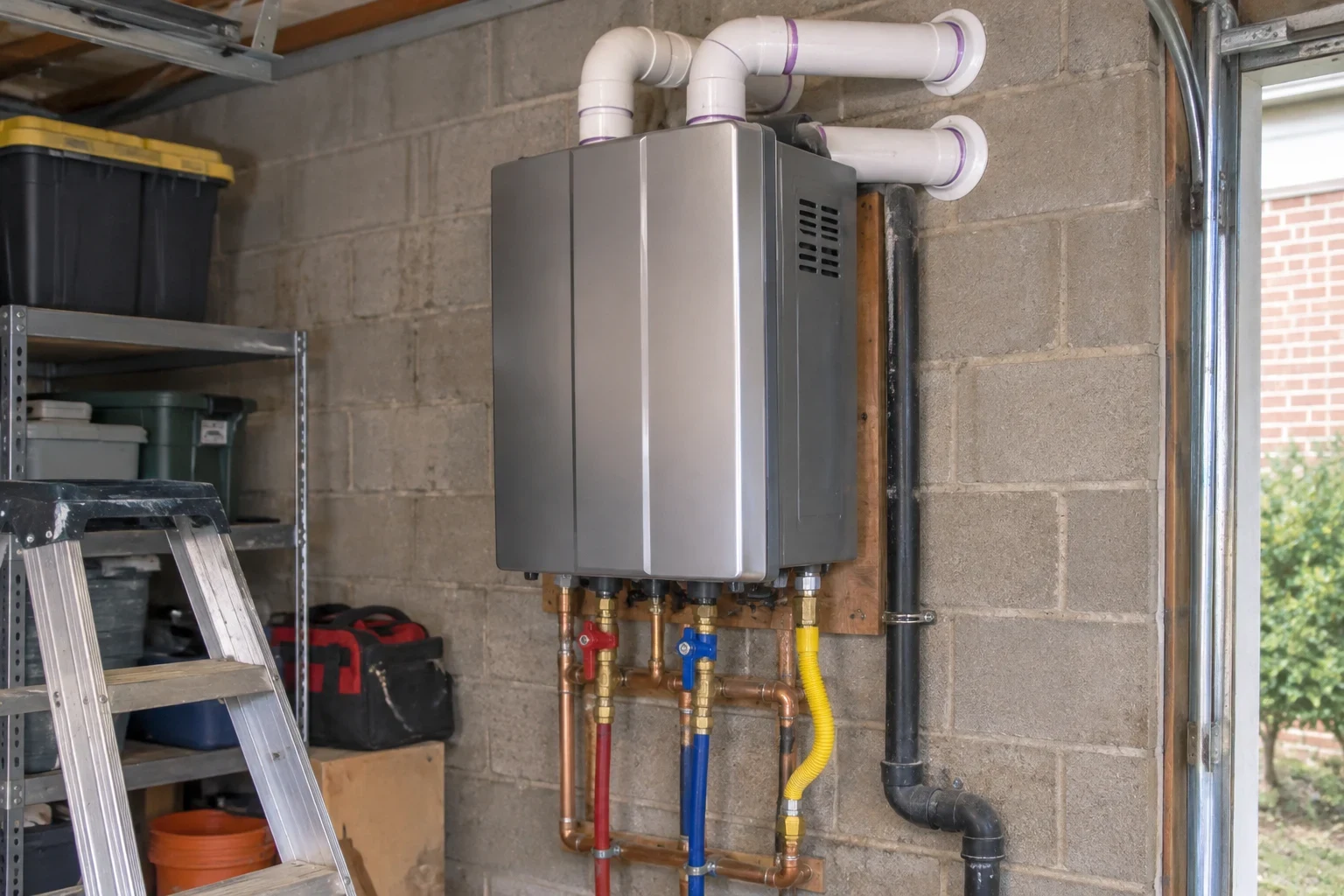
Is it worth replacing a tank water heater with a tankless?
For many homes it is worth it, especially if your tank is near the end of its life, you have natural gas and you plan to stay for years. You get endless hot water, a longer service life and back floor space. The upgrade costs more than a tank swap because the gas, venting and electrical often change.
What actually changes when you go tankless
A tank water heater keeps 40 or 50 gallons hot around the clock. When you open a faucet, you draw from that stored supply until it runs out, then wait while the burner or elements reheat it. Heat also slowly escapes through the tank walls all day, which is called standby loss.
A tankless unit stores almost nothing. A flow sensor detects water moving, the burner or elements fire, and the water heats as it passes through a heat exchanger. You stop paying to keep a tank warm, and you stop running out halfway through the third shower.
The tradeoff is that a tankless heater has a limit on how much water it can heat at once, measured in gallons per minute. A tank limits how much hot water you get in total. A tankless limits how many fixtures you can run at the same time.
When the switch makes sense, and when a new tank is smarter
We tell homeowners the truth on this one, because a tankless heater is not the right answer for every house. These are the situations where it usually pays off, and where it usually does not.
- Good fit: your tank is 8 years old or more and you are replacing it anyway, so you only pay for the upgrade once.
- Good fit: you have natural gas service and room on an outside wall for direct venting.
- Good fit: your household runs out of hot water, or you want the floor space a tank takes up in a closet or garage.
- Poor fit: you plan to sell within a few years and will not see enough savings to cover the added install work.
- Poor fit: your home is all-electric and the panel has no room for the large breakers an electric tankless needs.
- Poor fit: you want hot water during a power outage, since gas tankless units need electricity to run.
What the installation involves in an existing home
Swapping one tank for another is mostly a matter of reconnecting the same pipes. Going tankless usually means changes behind the walls, and that is where the cost and the planning live.
Gas line size is the first thing we check. A whole-house gas tankless unit can draw close to 200,000 BTU per hour, several times what a typical gas tank uses. Many existing half-inch gas lines cannot deliver that much, so the line from the meter or manifold may need to be upsized. An undersized line causes the unit to shut down or deliver lukewarm water under heavy use.
Venting changes too. The old metal flue that served your tank is usually not approved for a tankless unit. Condensing models vent through PVC and produce acidic condensate, which needs its own drain line and often a neutralizer. Electric models skip venting but may need two or three dedicated double-pole breakers, which can mean a panel upgrade. We also pull the permit for the gas and water heater work so the installation is inspected.
Sizing for cold winter water
Tankless units are sized by temperature rise: how many degrees the heater must add at a given flow rate. In Middle Tennessee, the water entering your home is noticeably colder in January than in August. A unit that keeps up with two showers in summer may only handle one and a dishwasher in winter.
We size for the coldest incoming water you will see, not the average. That means adding up the fixtures your family realistically runs at once, then choosing a unit that can deliver that flow at the full winter temperature rise. Getting this right is the difference between a heater you never think about and one that disappoints every February.
Hard water, maintenance and how long it lasts
Much of the water in this area runs through limestone, which leaves calcium and magnesium dissolved in it. In a tankless unit, that mineral scale builds up inside the narrow passages of the heat exchanger. Scale makes the unit work harder, triggers error codes and shortens its life.
The fix is simple maintenance: a yearly descaling flush through the isolation valves installed with the unit. If your water is especially hard, adding whole home water filtration or a scale-reducing treatment ahead of the heater protects it and every other fixture in your home.
With regular flushing, a tankless heater commonly outlasts a tank water heater by many years, and most parts, from the igniter to the flow sensor, can be replaced individually. A tank, once it starts leaking from the bottom, has to be replaced whole.
More questions about going tankless
Something not covered here? (615) 551-1523
Will a tankless heater give me hot water instantly at the faucet?
Not on its own. The water still has to travel from the heater to the fixture, so the wait is about the same as with a tank. A recirculation pump or a unit with a built-in recirculation feature can shorten that wait.
What is the cold water sandwich?
If you shut off a shower and turn it back on quickly, you may feel a short burst of cooler water while the burner relights. It lasts a few seconds and is normal for most tankless units.
Can I keep my old tank as a backup?
It is possible to plumb a tank in series as a storage buffer, but it brings back standby heat loss and takes up the same space. For most homes, a correctly sized single unit is the cleaner choice.
Can I pay for the upgrade over time?
Yes. We offer financing options, and we accept all major credit cards and cash.
Find out if tankless fits your home
Call and we will look at your gas line, venting, panel and hot water use, then give you a free estimate with a straight answer on tank versus tankless. If your current water heater has already failed, we offer 24/7 emergency plumbing service.